Starting out with a preface that I'm no great writer, writing is not my strong point, but conveying an answer and structure is. So Please endure through grammatical failures and see the wider points. God bless!
What is Adoptionism?
Adoptionism is the idea that Jesus was born a mere human and was later “adopted” as God’s Son — often at his baptism, resurrection, or exaltation.
Mainstream Christian theology rejects this because it conflicts with doctrines of Christ’s eternal divinity. But some scholars argue that the earliest layers of Christian tradition, especially in Mark, may preserve lower-Christology themes. So we’re going to dive into what that’s all about
Importantly:
- Mark never explicitly says “Jesus became divine at baptism.”
- The debate is about whether Mark’s wording implies something close to adoptionism.
Objection 1: Mark begins with Jesus already being “Son of God”
Gospel of Mark opens with:
“The beginning of the gospel of Jesus Christ, the Son of God” (Mark 1:1)
Why this is seen as a problem for adoptionism
If Jesus is already called “Son of God” before the baptism scene, then he was not adopted at baptism.
Adoptionist response
Adoptionist interpreters usually answer in one of two ways:
A. Mark 1:1 may be a later addition
Some manuscripts omit “Son of God,” leading some scholars to think the phrase was inserted later by scribes who wanted a stronger Christology.
B. Titles don’t necessarily imply metaphysical divinity
“Son of God” in Jewish usage could mean:
-
Messiah
-
king
-
chosen servant
-
righteous agent of God
It did not always mean “eternally divine second person of the Trinity.”
So the baptism could still function as Jesus’ installation or empowerment.
Response to adoptionism:
1. The textual evidence favors inclusion of “Son of God”
The omission of “Son of God” is supported by only a small minority of manuscripts, most notably Codex Sinaiticus before correction. The overwhelming manuscript tradition includes the phrase.
Textual Critic scholar Daniel Wallace argues, the omission is very plausibly accidental because of homoioteleuton — a scribal skipping caused by similar endings in Greek abbreviations.
The Greek sequence would have had repeated abbreviated sacred names (nomina sacra), making accidental omission highly conceivable. Wallace notes that Mark 1:1 has an unusually dense sequence of similar endings, exactly the kind of environment where scribal eye-skip occurs.
Modern textual critic Scholars such as:
- Daniel B. Wallace
- Tommy Wasserman
- Peter M. Head
have argued the longer reading is more likely authentic.
So the adoptionist cannot simply assume:
“Original Mark lacked Son of God.”
That is disputed and arguably unlikely.
So the adoptionist cannot confidently build theology on the shorter reading because:
- the external manuscript support is limited,
- the internal scribal explanation for omission is strong,
- and many modern textual scholars still favor the longer reading as original.
2. Mark frames the entire Gospel with divine sonship
Even if someone brackets Mark 1:1, sonship is not introduced for the first time at baptism.
The Gospel repeatedly presents Jesus as Son of God:
- demons recognize him (Mark 3:11; 5:7),
- the Father declares him Son at transfiguration,
- the high priest asks if he is “the Son of the Blessed,”
- the centurion climactically declares him “Son of God” at the cross.
Wallace and others note that Mark likely creates a Christological inclusio:
- “Son of God” at 1:1,
- “Truly this man was the Son of God” at 15:39.
That literary structure strongly suggests Mark wants readers to interpret the entire narrative through the lens of Jesus’ sonship from the outset.
An adoptionist reading struggles because:
- Mark does not narrate a change in Jesus’ identity,
- he narrates a revelation of identity.
3. The baptism language does not naturally imply ontological change
At baptism the voice says:
“You are my beloved Son.”
But nothing in the text says:
- “Today I have become your Father,”
- or “Now you are my Son.”
That matters enormously.
If Mark intended literal adoption, Psalm 2:7’s explicit enthronement formula (“Today I have begotten you”) would have been the clearest wording available.
Interestingly, some later traditions did use the “Today I have begotten you” reading in Luke’s baptism account, and those traditions became associated with adoptionist groups.
But Mark does not use that formula.
Instead, Mark’s wording sounds more like:
- affirmation,
- disclosure,
- commissioning.
So the text itself lacks the decisive adoption formula one would expect if adoptionism were the point.
Also: Immediately after Mark 1:1, Mark cites:
- Isaiah 40:3
- Malachi 3:1
These passages originally refer to preparation for the coming of YHWH himself.
Mark applies them to Jesus.
So the narrative structure is:
- Jesus is introduced as Son of God.
- John prepares the way.
- The “way of the Lord (YHWH)” prophecy is fulfilled in Jesus.
That is a very high Christology already in chapter 1.
Adoptionism struggles here because Mark is not merely saying:
“God chose a man.”
He is identifying Jesus with the coming Lord of Isaiah’s prophecy.
This argument is stronger than merely debating the phrase “Son of God.”
4. Mark portrays Jesus as uniquely transcendent before and beyond baptism categories
Even early in Mark:
- Jesus forgives sins directly,
- commands nature,
- exercises authority over Torah,
- receives reactions reserved for divine authority.
The issue is not merely that Jesus is Spirit-empowered.
Prophets were Spirit-empowered too.
But in Gospel of Mark Jesus acts with intrinsic authority:
- “I say to you,”
- “the Son of Man has authority on earth to forgive sins,”
- “Lord even of the Sabbath.”
The narrative weight exceeds mere royal adoption categories.
5: The baptism language does not naturally imply adoption
If Mark intended adoptionism, we would expect clearer language like:
- “Today I have begotten you” (Psalm 2:7),
- or explicit becoming language.
But Mark 1:11 says:
“You are my beloved Son.”
Not:
“Today you became my Son.”
That distinction matters.
In fact, some early traditions did use the wording:
“Today I have begotten you”
in baptism accounts.
But Mark does not.
That omission is significant because if Mark wanted to teach adoptionism clearly, he bypassed the clearest possible wording.
6: Demons recognize Jesus immediately
In Gospel of Mark, supernatural beings already know who Jesus is very early:
- “Holy One of God” (1:24)
- “Son of God” (3:11)
The narrative suggests Jesus possesses an identity hidden from humans but known in the spiritual realm.
That fits revelation Christology better than adoption Christology.
In other words:
- Mark’s theme is concealed identity,
- not newly acquired identity
7. The secrecy motif actually works against adoptionism
A very important point.
In Mark, people gradually discover who Jesus already is.
This is the famous “Messianic Secret.”
Demons know his identity before the crowds do.
The disciples slowly realize it.
The centurion finally confesses it openly.
That pattern only makes sense if:
- Jesus already possesses the identity,
- but it is progressively unveiled.
If adoption occurred at baptism, the secrecy motif becomes oddly unnecessary; Mark could simply announce the transformation clearly.
Instead, Mark writes like someone revealing a hidden truth already present.
8. Historically, adoptionism fits poorly with Mark’s Jewish background
In Second Temple Judaism, “Son of God” language for kings or messianic figures existed, yes.
But Mark pushes beyond ordinary royal metaphor through:
- authority over creation,
- forgiveness of sins,
- eschatological Son of Man imagery,
- enthronement beside divine power (Mark 14:62).
This is why many scholars say Mark has an “early high Christology,” even if not yet Nicene theology.
So the options are not simply:
- “fully Nicene”
or - “adoptionist.”
Mark may already reflect a very exalted Christology without later metaphysical precision.
Objection 2: The baptism scene sounds like revelation, not adoption
At the baptism:
“You are my beloved Son; with you I am well pleased.” (Mark 1:11)
Many argue this is God publicly revealing who Jesus already is.
Adoptionist response
Adoptionist readings point out that the wording echoes:
- Psalm 2 (“You are my son” — royal enthronement language)
- Isaiah 42 (God’s chosen servant)
This combination can sound like:
- commissioning,
- enthronement,
- appointment to mission.
In ancient royal ideology, kings could become God’s “son” at enthronement without being literally divine beforehand.
Response to adoptionism:
1. Mark conspicuously avoids explicit adoption language
This is probably the strongest point.
If Mark intended readers to think Jesus became God’s Son at baptism, he had a very obvious phrase available from Psalm 2:7:
“You are my Son; today I have begotten you.”
But Mark does not quote the crucial adoption-like portion:
- not “today,”
- not “begotten,”
- not “become.”
Instead he writes:
“You are my beloved Son; with you I am well pleased.”
That wording leans much more toward:
- affirmation,
- delight,
- recognition,
- commissioning.
In other words:
- adoption language would emphasize change,
- Mark emphasizes relationship.
This distinction is extremely important.
2. The Isaiah background weakens adoptionism more than it helps it
Adoptionists often point to Psalm 2.
But Mark’s wording also strongly echoes Isaiah 42:1:
“Behold my servant, whom I uphold, my chosen, in whom my soul delights.”
That matters because Isaiah 42 is not about someone becoming God’s servant.
It is about:
- the revelation of the servant,
- divine approval,
- inauguration of mission.
It is not the son receiving a promotion, it is not metaphysical adoption.
3. The heavens opening suggests revelation, not promotion
Mark says:
“He saw the heavens being torn open…”
This imagery is apocalyptic revelation language.
The point is:
- heaven is unveiling divine truth,
- not changing Jesus’ essence.
The scene functions like a disclosure event:
God reveals who Jesus is and empowers his mission publicly.
That fits the broader Markan pattern where hidden identity becomes progressively disclosed.
4. The Spirit descending does not imply prior lack of sonship
Adoptionists often argue:
- Jesus receives the Spirit,
- therefore he becomes Son at baptism.
But in biblical theology, receiving the Spirit does not mean someone previously lacked divine relationship.
Examples:
- prophets receive empowerment for mission,
- kings are anointed for office,
- servants are equipped for vocation.
The Spirit’s descent in Mark fits inauguration of ministry much better than ontological elevation from “mere man” to “Son of God.”
The baptism marks:
- the beginning of public ministry,
not - the beginning of Jesus’ existence as Son.
5. Mark’s audience already knows Jesus’ identity before the baptism scene unfolds
This is a subtle but powerful literary argument.
Even apart from textual debates over Mark 1:1, the narrative itself is written so readers interpret the baptism through prior framing.
Mark introduces:
- John as forerunner,
- fulfillment motifs,
- divine preparation language.
The baptism is therefore not narrated as:
“Now Jesus becomes something new.”
Instead it reads as:
“Now heaven publicly confirms who Jesus is.”
The literary effect is revelatory, not transformational.
6. The transfiguration confirms the revelatory reading
At the transfiguration, the Father says essentially the same thing again:
“This is my beloved Son.”
But nobody argues Jesus becomes Son again at the transfiguration.
So why assume the baptism declaration means literal adoption?
The repetition strongly suggests:
- divine testimony,
- confirmation,
- revelation to others.
Not ontological change.
The baptism and transfiguration function like two heavenly witness scenes bracketing Jesus’ ministry.
7. Early adoptionists preferred other textual traditions for a reason
This historical point is very useful.
Some early adoptionist groups favoured a variant reading in Gospel of Luke 3:22 that explicitly said:
“Today I have begotten you.”
That wording is much more naturally adoptionistic.
But Mark does not preserve that reading.
That difference matters because it shows:
- ancient readers themselves recognised which wording sounded adoptionistic,
- and Mark’s wording was comparatively weaker for that theology.
If Mark clearly taught adoptionism, later adoptionists would not have needed alternative baptism formulas.
Objection 3: Mark portrays Jesus with extraordinary authority before resurrection
In Gospel of Mark Jesus:
- forgives sins,
- commands demons,
- controls nature,
- redefines Sabbath law.
These seem too exalted for a “mere man.”
Adoptionist response
The response is usually:
- adoptionism does not necessarily mean “ordinary powerless human.”
- It can mean a human uniquely empowered by God’s Spirit.
At baptism, the Spirit descends on Jesus. After that point:
- miracles begin,
- authority emerges,
- demons recognise him.
So adoptionists say Mark intentionally ties Jesus’ authority to Spirit-anointing.
Response to adoptionism:
1. Mark portrays Jesus as possessing authority, not merely channeling it
Prophets in the Hebrew Bible typically say:
“Thus says the Lord.”
They act as intermediaries.
But in Gospel of Mark: Jesus repeatedly speaks and acts on his own authority:
- “I say to you…”
- “Your sins are forgiven.”
- “The Son of Man is lord even of the Sabbath.”
The difference is profound.
Jesus is not merely delivering God’s message. He acts as the direct locus of authority itself.
Mark 1:22 explicitly emphasizes this:
He taught “as one having authority, and not as the scribes.”
The issue is not merely miraculous power. It is the kind of authority being exercised.
2. Forgiving sins is treated as uniquely divine in the narrative
In Mark 2, when Jesus forgives the paralytic’s sins, the scribes respond:
“Who can forgive sins but God alone?”
This is crucial because Mark does not portray their logic as completely mistaken.
Instead, Jesus validates his authority by healing the man.
The narrative tension is:
- not whether forgiveness belongs to God,
- but whether Jesus legitimately possesses divine prerogative.
If Mark merely meant:
“Jesus is a Spirit-filled prophet,”
then the controversy is strangely overstated.
Prophets could announce God’s forgiveness.
But Jesus forgives directly and personally.
That exceeds normal prophetic categories.
3. Jesus does not invoke external divine power during miracles
Another important distinction.
Biblical miracle workers often:
- pray for power,
- invoke God’s name,
- perform symbolic acts dependent on divine intervention.
But in Mark, Jesus frequently commands directly:
- “Be silent.”
- “Come out of him.”
- “Peace! Be still!”
And creation obeys immediately.
The disciples react in astonishment:
“Who then is this, that even the wind and sea obey him?”
That question matters because in Jewish Scripture:
- the sea obeys God,
- storms are subdued by God,
- chaotic waters symbolize divine sovereignty.
Mark is presenting more than Spirit-anointed prophecy.
4. “Lord of the Sabbath” goes beyond prophetic reform
Adoptionists sometimes compare Jesus to prophets critiquing legalism.
But Jesus’ claim in Mark 2 is much stronger:
“The Son of Man is lord even of the Sabbath.”
The Sabbath was not merely a tradition.
It was a divine institution rooted in creation itself.
Claiming lordship over it is extraordinary.
A prophet may interpret Torah.
Jesus places himself above a creation ordinance established by God.
That is a radically exalted claim.
5. Spirit-anointing does not explain the full scope of Mark’s Christology
This is an important synthesis point.
The Spirit’s descent explains:
- inauguration of mission,
- empowerment for ministry,
- messianic commissioning.
But it does not adequately explain:
- authority to forgive sins,
- lordship over Sabbath,
- mastery over creation,
- enthronement at God’s right hand,
- universal eschatological authority.
Adoptionism can explain empowerment. It struggles to explain the nature and scope of Jesus’ authority in Mark.
6. Mark’s narrative consistently pushes readers beyond prophet categories
Throughout the Gospel, people repeatedly try to categorise Jesus:
- prophet,
- teacher,
- miracle worker,
- Davidic Messiah.
But Mark constantly pushes beyond those labels.
That is why the disciples repeatedly ask:
“Who then is this?”
The Gospel’s tension depends on Jesus transcending existing categories.
If Mark intended merely:
“Spirit-filled human Messiah,”
many of these scenes lose their dramatic force.
Objection 4: Mark contains hints of preexistence
Some argue passages imply Jesus existed before earthly life.
Examples include:
- Mark 12:1–12 (beloved son sent after servants)
- Mark 13:26 (Son of Man imagery)
- Mark 14:62 (heavenly enthronement language)
Adoptionist response
Adoptionists argue these texts reflect:
- exaltation after mission,
- apocalyptic authority,
- symbolic roles.
They say none explicitly teaches eternal preexistence in the way later texts like Gospel of John do.
They often emphasize the contrast:
- John: “In the beginning was the Word”
- Mark: begins with baptism/ministry.
Response to adoptionism:
1. Lack of Johannine language does not equal adoptionism
This is the foundational point.
The adoptionist argument often assumes:
“If Mark doesn’t sound like John, then Mark must have a low/adoptionist Christology.”
But that is a false dichotomy.
Early Christian Christology developed in multiple literary forms.
A Gospel can present:
- implicit transcendence,
- divine authority,
- heavenly identity,
Without using John’s explicit metaphysical vocabulary.
In other words:
- John is more explicit,
- but Mark may still reflect an already exalted understanding of Jesus.
The question is not:
“Does Mark equal John?”
The question is:
“Does Mark fit comfortably with a merely adopted human Messiah?”
And several passages suggest the answer is no.
2. The Parable of the Vineyard distinguishes the Son from all prophets
In Mark 12:1–12:
- servants are sent repeatedly,
- then finally the “beloved son” is sent.
This distinction is crucial.
The son is not merely:
- another messenger,
- another prophet,
- another servant.
He stands in a categorically unique relationship to the owner.
The sequence builds upward:
servants → many servants → beloved son.
That literary structure suggests qualitative distinction, not mere rank.
Adoptionists often reduce this to symbolic messianism, but the force of the parable is that the son is fundamentally different from those who came before him.
3. The “beloved Son” language echoes transcendent categories throughout Mark
The phrase “beloved Son” appears repeatedly:
- baptism,
- transfiguration,
- vineyard parable.
This creates a unified Christological thread.
Importantly, the sonship language in Mark is not merely royal-political.
It carries a singular and exclusive quality.
Jesus is not presented as:
- one son among many,
- one prophet among others.
He is the beloved Son in a unique sense.
That cumulative pattern pushes beyond ordinary adoption categories.
4. Mark 13 and 14 portray Jesus participating in divine eschatological authority
This is one of the strongest points against simplistic adoptionism.
In Mark 14:62 Jesus says:
“You will see the Son of Man seated at the right hand of Power and coming with the clouds of heaven.”
This combines:
- Psalm 110,
- Daniel 7.
The Daniel 7 imagery is especially significant because “coming with the clouds” is associated with divine prerogative in Jewish thought.
Cloud-riding imagery in the Hebrew Bible is repeatedly connected with God himself.
So Mark presents Jesus as participating in:
- heavenly rule,
- divine judgment,
- cosmic authority.
Adoptionists may call this “post-resurrection exaltation,” but even then the question remains:
How can a merely adopted human share functions and imagery so closely associated with divine sovereignty?
The problem is not simply exaltation.
It is the kind of exaltation.
5. The high priest reacts as though Jesus’ claim is extraordinarily transcendent
In Mark 14, the high priest tears his garments and accuses Jesus of blasphemy.
That reaction matters.
If Jesus were merely claiming:
- messianic status,
- prophetic authority,
- future vindication,
the response becomes difficult to explain at this intensity. Mark portrays Jesus’ statement as crossing into sacred territory. The narrative itself signals that Jesus is claiming far more than ordinary messianic office.
6. Adoptionism struggles with continuity of identity
This is a very important conceptual weakness.
Adoptionism often treats:
- earthly Jesus = ordinary man,
- exalted Jesus = transformed heavenly ruler.
But Mark’s narrative emphasizes continuity.
The same Jesus who:
- forgives sins,
- commands storms,
- silences demons,
is the one later enthroned beside Power.
The exaltation vindicates and unveils who he already is; it does not introduce a fundamentally new identity.
That narrative continuity weakens the adoptionist reading substantially.
Objection 5: The transfiguration assumes Jesus was already divine
At the transfiguration (Mark 9), God again says:
“This is my beloved Son.”
Adoptionist response
Adoptionists usually argue this reinforces Jesus’ chosen status rather than eternal ontology.
The transfiguration can be read as:
- confirmation,
- glorification,
- prophetic vindication.
Moses and Elijah also appear glorified without being divine beings.
Response to adoptionism:
1. The transfiguration does not merely glorify Jesus — it uniquely elevates him above Moses and Elijah
This is the central point.
Moses and Elijah appear briefly, but the narrative focus overwhelmingly centres on Jesus.
Peter proposes:
“Let us make three tents…”
But the heavenly voice immediately redirects attention exclusively to Jesus:
“This is my beloved Son; listen to him.”
Then Moses and Elijah disappear, and:
“They no longer saw anyone with them except Jesus only.”
That ending is extremely significant.
The scene is not presenting three equivalent glorified figures.
It is subordinating Moses and Elijah to Jesus.
2. “Listen to him” places Jesus above the Law and the Prophets
Moses represents:
- Torah,
- covenant,
- foundational revelation.
Elijah represents:
- prophetic authority,
- restoration,
- eschatological expectation.
Yet the heavenly voice singles out Jesus alone as the decisive authority.
That is far more than prophetic vindication.
Mark presents Jesus as the climactic and superior revelation to Israel’s greatest figures.
An adoptionist reading struggles to explain why a merely adopted human is elevated above:
- the giver of the Law,
- and the greatest prophet.
3. The imagery surrounding Jesus is uniquely divine in tone
Mark describes:
- dazzling radiance,
- overshadowing cloud,
- heavenly voice.
The cloud imagery especially matters because in Jewish tradition the cloud frequently signifies divine presence:
- Sinai,
- tabernacle,
- temple glory.
The transfiguration is therefore not simply:
“God approves Jesus.”
It is a theophanic scene in which Jesus stands at the centre of divine glory.
Moses reflected divine glory.
Jesus radiates within it.
That distinction is important.
4. Moses and Elijah are attendants, not parallels
Adoptionists often argue:
“Moses and Elijah appear glorified too.”
But Mark’s narrative role for them is fundamentally different.
They function as:
- witnesses,
- representatives of Israel’s history,
- testimony to Jesus.
The scene climaxes not in their glorification but in their disappearance.
Jesus alone remains.
That narrative movement strongly suggests supremacy, not simple companionship among heavenly figures.
5. The disciples’ fear reflects encounter with divine mystery, not ordinary prophetic glory
Mark repeatedly notes the disciples’ terror and confusion during divine revelation scenes.
At the transfiguration:
- they are overwhelmed,
- frightened,
- unable to process what they are witnessing.
This reaction fits theophanic encounters in Jewish Scripture.
The atmosphere is not merely:
“A prophet receives heavenly honour.”
It is an encounter with transcendent divine revelation centred on Jesus himself.
6. The resurrection connection weakens adoptionism further
Immediately after the transfiguration, Jesus speaks about:
- rising from the dead,
- the hidden nature of his identity,
- future vindication.
The transfiguration therefore anticipates resurrection glory.
But in Mark, resurrection does not create Jesus’ sonship; it unveils and vindicates it.
The same pattern appears throughout the Gospel:
hidden identity progressively revealed.
That narrative structure fits revelation much better than adoption.
Objection 6: Early Christians outside Mark clearly rejected adoptionism
Later Christian writers strongly opposed adoptionism as heresy.
Examples include:
- Ignatius of Antioch
- Irenaeus
- Athanasius
Adoptionist response
Scholars who see adoptionist tendencies in Mark often argue:
- early Christianity contained multiple Christologies,
- doctrine developed over time,
- later orthodoxy standardized one interpretation.
So they would say:
- opposition to adoptionism later does not prove Mark himself lacked lower-Christology elements.
Response to adoptionism:
1. The earliest post-apostolic writers already display strikingly high Christology
This is extremely important historically.
Writers very close to the apostolic period — such as Ignatius of Antioch — speak of Jesus in remarkably exalted terms:
- preexistence,
- incarnation,
- divine identity,
- worship-worthy status.
And this appears very early, not centuries later.
That matters because it weakens the claim that “high Christology” was merely a late theological invention imposed onto primitive Christianity.
The trajectory toward exalted Christology appears almost immediately in surviving Christian sources.
2. There is little evidence the mainstream early Church read Mark as adoptionist
This point is often overlooked.
If Gospel of Mark naturally taught adoptionism, we would expect:
- widespread early appeals to Mark by adoptionist groups,
- major debates over Mark’s meaning specifically,
- or patristic concern that Mark itself promoted adoptionism.
But we do not really see that.
Instead:
- orthodox writers freely used Mark,
- adoptionists often relied more heavily on specific textual variants or other traditions,
- and the broader Church consistently read the Gospel canon as coherent rather than fundamentally contradictory.
That does not prove Mark could not be read in a lower-Christology way, but it significantly weakens the claim that adoptionism is the most natural reading.
3. Development does not necessarily mean contradiction
Adoptionist arguments sometimes assume:
“If doctrine developed, then earlier texts must have taught something substantially different.”
But development can also mean:
- clarification,
- precision,
- conceptual refinement.
Johns Gospel is often discussed as filling in some gaps from the synoptic gospels like names (Malcus is named in John, but just the act done to him is mentioned in the synoptics) . Which is why that gospel is assumed to come after the first three
For example:
- Nicene theology is more philosophically precise than Mark,
- but precision is not the same thing as invention.
A seed can develop into a tree without becoming a different organism.
Likewise, later Trinitarian language may formalise themes already present in embryonic form within Mark:
- divine authority,
- unique sonship,
- heavenly enthronement,
- participation in divine prerogatives.
4. Adoptionism struggles to explain why later Christians found it incompatible with apostolic faith
This is an important historical observation.
The early Church did not reject adoptionism merely because:
“It sounded different.”
They rejected it because they believed it failed to account for:
- Jesus’ divine prerogatives,
- worship practices,
- resurrection significance,
- apostolic teaching,
- and the broader scriptural witness.
In other words, adoptionism was not rejected arbitrarily.
It was seen as insufficient to explain the totality of Christian belief already in circulation.
5. The burden of proof still rests on showing Mark actually teaches adoptionism
This is the decisive methodological point.
Even if doctrinal development (like clarification) occurred. none of that demonstrates that Mark itself presents Jesus as:
- originally a mere man,
- was later adopted into divine sonship.
The adoptionist still has to prove that from the text itself.
And as we have seen in previous objections, Mark repeatedly portrays Jesus in ways that strain purely adoptionist categories.
Objection 7: Mark’s silence about virgin birth does not prove adoptionism
Unlike Gospel of Matthew and Gospel of Luke, Mark has no birth narrative.
Adoptionist response
Adoptionists agree silence alone proves nothing. But they argue:
- if Mark believed strongly in virginal divine sonship,
- it is notable that he begins instead with baptism.
So they see the baptism as Mark’s theological starting point.
Response to adoptionism:
1. Narrative starting point does not equal ontological beginning
This is the foundational reply.
Gospel of Mark begins with:
- John the Baptist,
- Jesus’ public ministry,
- the inauguration of mission.
But beginning a narrative at a certain moment does not mean:
“This is when the person came into existence as who they are.”
a. Ancient biographies often omitted birth accounts entirely.
In his Parallel Lives, Plutarch explicitly says biography is concerned chiefly with revealing character through deeds rather than chronicling every stage of life.
Many of his biographies move quickly into adulthood and political or military activity rather than dwelling on birth stories.
For example:
- Life of Alexander focuses rapidly on Alexander’s education, temperament, and campaigns.
- Life of Cato Minor concentrates heavily on moral character and political conduct.
A useful quotation from Plutarch:
“It is not histories that I am writing, but lives.”
b. Suetonius structures biographies around public actions and character themes
In The Twelve Caesars, Suetonius usually includes some ancestry material, but his biographies are not primarily infancy narratives.
Instead, they rapidly move into:
- political career,
- public deeds,
- moral character,
- habits,
- rule,
- scandals,
- death.
Importantly, Suetonius himself explicitly says he abandons strict chronology to organise material thematically around the subject’s character and conduct.
c. Xenophon’s works often focus on leadership and deeds rather than birth accounts
Works such as:
- Agesilaus,
- Cyropaedia,
are heavily concerned with:
- leadership,
- virtue,
- political and military action.
The emphasis is not on detailed infancy narrative but on the subject’s public significance and character formation.
d. Modern scholarship widely recognises the Gospels as ancient biographies (bioi)
Ancient biographies did not require:
- infancy narratives,
- chronological completeness,
- or equal attention to every life stage.
Craig Keener summarises the scholarly consensus:
“A majority of scholars today recognise that the Gospels are ancient biographies.”
Mark appears focused on:
- proclamation,
- conflict,
- authority,
- suffering,
- and the Kingdom of God.
His Gospel is fast-moving and ministry-centred from the outset.
So the absence of infancy material may reflect literary purpose rather than theological denial.
2. Silence about virgin birth is not evidence against exalted Christology
This is extremely important methodologically.
Mark also omits many things:
- resurrection appearances in the shorter ending,
- detailed teaching sections found elsewhere,
- infancy narratives,
- extended post-resurrection discourse.
But omission is not equivalent to rejection.
If silence proved disbelief, we would have to conclude Mark rejected numerous doctrines simply because he does not mention them explicitly.
That is a weak historical method.
3. Mark already frames Jesus in extraordinary terms from the opening
Even without a birth narrative, Mark introduces Jesus with remarkable theological weight:
- fulfilment of prophecy,
- divine preparation language,
- unique sonship themes,
- authority surpassing prophets and scribes.
The Gospel immediately places Jesus within a transcendent framework.
So Mark’s omission of infancy material does not result in a merely human portrait.
In fact, the Christological claims emerge almost immediately.
4. The “beginning” language may imply deliberate selectivity
Mark 1:1 says:
“The beginning of the gospel of Jesus Christ…”
This may signal:
- not absolute beginning,
- but the beginning of the proclaimed gospel narrative.
In other words, Mark is intentionally beginning at the launch of Jesus’ public mission.
The Gospel never claims:
“Nothing significant preceded this.”
It simply chooses where to enter the story.
Summary
Across all seven objections, the adoptionist reading of Mark consistently relies on the idea that silence, narrative starting points, or Spirit-based empowerment can be used to reconstruct an “adoption event” at Jesus’ baptism. But when each argument is examined closely, a different pattern emerges: Gospel of Mark does not narrate a transition from ordinary human status to divine sonship, but rather a progressive revelation of an identity that is already assumed, repeatedly affirmed, and expressed through categories that exceed simple Spirit-anointed agency. Mark’s narrative structure, language of authority, Son of Man traditions, unique sonship motifs, and transfiguration scene all converge on a consistent Christological trajectory: Jesus is disclosed, not adopted; recognised, not transformed; and vindicated, not promoted into a new ontological category. While Mark lacks the explicit metaphysical vocabulary of later texts like Gospel of John, the cumulative weight of his narrative resists reduction to a purely adoptionist framework.
| # | Claim (Mark text/theme) | Adoptionist objection | Response |
|---|---|---|---|
| 1 | “Son of God” in Mark 1:1 frames Jesus’ identity early | Phrase may be later addition; sonship begins at baptism | Strong manuscript support for inclusion + Mark frames sonship as continuous revelation, not newly acquired status |
| 2 | Baptism scene declares “You are my beloved Son” | This is adoption/enthronement language at baptism | No explicit “becoming” language; echoes Isaiah 42 commissioning; scene functions as revelation, not transformation |
| 3 | Jesus exercises divine authority (sins, nature, law) | Authority comes from Spirit after baptism | Jesus speaks/acts with intrinsic authority (“I say to you”); forgiveness and cosmic command exceed prophetic agency |
| 4 | Son of Man / vineyard / enthronement texts imply transcendence | These are symbolic exaltation or post-mission roles | Narrative distinguishes the Son from all others; Danielic enthronement and Psalm 110 imagery exceed adoption categories |
| 5 | Transfiguration declares divine sonship again | Merely confirmation and glorification like Moses/Elijah | Moses and Elijah vanish; Jesus alone remains; “listen to him” elevates him above Law and Prophets |
| 6 | Later fathers reject adoptionism | Doctrine developed; later orthodoxy reshaped interpretation | Early sources already show high Christology; little evidence Mark was read as adoptionist; diversity ≠ adoptionism |
| 7 | No virgin birth in Mark; baptism is starting point | Silence suggests baptism is origin of sonship | Ancient biographies often begin at public mission; baptism is commissioning/revelation, not ontological origin |
Reading Recommendation:
The Preexistent Son: Recovering the Christologies of Matthew, Mark, and Luke
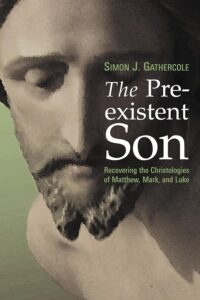
In this challenging book, rising New Testament scholar Simon
Gathercole contradicts a commonly held view among biblical scholars — that the Gospel of John is the only Gospel to give evidence for Jesus’ heavenly identity and preexistence. The Preexistent Son demonstrates that Matthew, Mark, and Luke were also well aware that the Son of God existed with the Father prior to his earthly ministry. Gathercole supports his argument by considering the “I have come” sayings of Jesus
and strikingly similar angelic sayings discovered in Second Temple and Rabbinic literature. Further, he considers related topics such as Wisdom Christology and the titles applied to Jesus in the Synoptic Gospels. Gathercole’s carefully researched work should spark debate among Synoptic scholars and extend the understanding of anyone interested in this New Testament question. (Source: Amazon)
https://www.amazon.co.uk/Pre-existent-Son-Recovering-Christologies-Matthew/dp/0802829015


